mejadra with garlic cucumber salad
July 4, 2013

We had dinner with our friends Colette and David the other night and they made this awesome mejadra. It’s from Ottolenghi (who else?) and I’ve been wanting to try it forever but have just never gotten around to it. So, with a kick in the pants from our dear friends, and Ottolenghi’s cookbook always at the ready, I whipped this up for dinner last night and it was fabulous, especially with a side of Ottolenghi’s cucumber salad. For those of you wondering, mejadra, also know as Mujaddara, moujadara, mudardara, and megadarra is a dish of cooked lentils together with rice and garnished with sautéed onions. Mujaddara is the Arabic word for smallpox because of the look of the the lentils among the rice. The first recorded recipe for mujaddara appears in Kitab al-Tabikh, a cookbook compiled in 1226 by al-Baghdadi in Iraq. Because of its importance in the Arabic diet, a saying in the Eastern Arab world is, “A hungry man would be willing to sell his soul for a dish of mujaddara.” It’s almost that good.

Mejadera
1 cup sunflower oil
4 medium onions, thinly sliced
1 1/2 cups green or brown lentils
2 tsps cumin seed
1½ tbsp coriander seeds
1 cup basmati rice
2 tbsps olive oil
½ tsp ground turmeric
1½ tsp ground allspice
1½ tsp ground cinnamon
1 tsp sugar
Salt and black pepper
2 cups water
Heat the sunflower oil in a medium-size heavy-based saucepan. When very hot, carefully add a third of the sliced onion. Fry for five to seven minutes, stirring occasionally with a slotted spoon, until the onion takes on a nice, golden-brown colour and turns crispy. Use the spoon to transfer the onion to a colander and sprinkle with salt. Repeat with two more batches of onion.
Meanwhile, put the lentils in a small saucepan, cover with plenty of water, bring to a boil and cook for 12-15 minutes, or until the lentils have softened but still have a little bite. Drain into a colander.
Wipe clean the saucepan in which you fried the onion and drop in the cumin and coriander seeds. Place over a medium heat and toast the seeds for a minute or two, until they release those distinctive aromas. Add the rice, olive oil, turmeric, allspice, cinnamon, sugar, half a teaspoon of salt and plenty of black pepper. Stir to coat the rice with oil, then add the cooked lentils and water. Bring to a boil, cover and simmer on very low heat for 15 minutes.
Remove from the heat, lift off the lid and cover the pan with a clean tea towel. Seal tightly with the lid and set aside for 10 minutes. Finally, tip the rice and lentils into a large mixing bowl. Add half the fried onion and stir gently with a fork. Pile up in a shallow serving bowl and top with the rest of the onion.
green couscous
June 9, 2013

Today I’m honouring healing, comfort, and simplicity. 3 words I will hold throughout the day. As the buddhist munks at Tassajara say “There is something very mysterious that happens when attentive minds prepare and cook food,” and I say bring it on. So in my preparation of this dish inspired by the fabulous Ottolenghi, and as I head into the rest of the day, my attentive mind will rest on these truths. The reason I choose this dish is that it embodies healing, comfort, and simplicity: it’s packed full of nature’s medicine in the form of parsley, cilantro, dill and other healing herbs; it’s a comfort food right up there with the very best we all remember from our childhood; and it takes no time to prepare and is grounded in its list of basic, elemental ingredients. So cook, eat, be attentive, and fill the world with more of the things we need. “Be and be better.”
1 cup israeli couscous
¾ cup boiling water or vegetable stock
1 small onion, thinly sliced
1 tbsp olive oil
¼ tsp salt
¼ tsp ground cumin
Herb paste:
1/3 cup chopped parsley
1 cup chopped cilantro
2 tbsp chopped tarragon
2 tbsp chopped dill
2 tbsp chopped mint
6 tbsp olive oil
½ cup unsalted pistachios, toasted and roughly chopped
3 green onions, finely sliced
1 fresh green chile, finely sliced
chives and chive flowers for garnish
Place the couscous in a large bowl and cover with the boiling water or stock. Cover the bowl with plastic wrap and leave for 10 minutes.
Meanwhile, fry the onion in the olive oil on medium until golden and completely soft. Add the salt and cumin and mix well. Leave to cool slightly.
To make the herb paste, place all the ingredients in a food processor and blitz until smooth.
Add the herb paste to the couscous and mix everything together well with a fork to fluff it up. Now add the cooked onion, the pistachios, green onions, and green chile and gently mix. Garnish with chives and chive flowers. Serve at room temperature.
warm honey mustard spinach salad with pecans
May 26, 2013

Wiki tells me that “Spinach is thought to have originated in ancient Persia (modern Iran and neighboring countries). Arab traders carried spinach into India, and then the plant was introduced into ancient China, where it was known as “Persian vegetable.” The earliest available record of the spinach plant was recorded in Chinese, stating it was introduced into China via Nepal (probably in 647 AD). In AD 827, the Saracens introduced spinach to Sicily. The first written evidence of spinach in the Mediterranean was recorded in the medical work by al-Razi.” Which kind of makes sense – that it would be in a medical work – because it’s highly nutritional and full of antioxidants. What’s more, there is nothing like the spring baby spinach you find at the farmers’ markets at this time of year – small, tender, and bright green. With a little warm honey mustard dressing and toasted pecans, those Arab traders would think they had died and gone to heaven.
1 bunch of fresh baby spinach
1/4 tsp garlic, minced
1 1/2 tsps shallots, minced
2 tbsps dijon
1/4 cup honey
1/4 cup red wine vinegar
1/2 cup olive oil
1/2 cup pecans, chopped coarsely
Wash and dry (spin) the spinach and set aside.
Mix garlic, shallots, dijon, honey, and red wine vinegar in a small saucepan. Heat over medium-high heat and let it come to a boil. Turn the heat down to low and let the mixture simmer for 5 minutes. Remove from heat. Let it cool down slightly and then slowly wisk the olive oil into the other ingredients until mixed well. Set aside.
Toast pecans in a small skillet over medium-high heat. Be careful not to burn them but to just toast them until golden brown and fragrant.
Toss the spinach with a generous dose of dressing. Top with toasted pecans and serve alongside a falafel burger or my favourite VLT.
tian boats
May 10, 2013

Back in July 2011 I posted a tian recipe which is super tasty and has been requested by dinner guests ever since. I will continue to love it and make it but this week I had a brilliant idea. Why not make tian boats that use one of the main ingredients, red pepper, as the vessel in which to bake these layered Mediterranean vegetables? I noted in the original post that a tian is a conical earthenware cooking vessel used in the Alpes-Maritimes area of France. But if you don’t live in the Alpes-Maritimes area of France, or you can’t source said conical earthenware vessel, or you are just plan lazy and want to take a short-cut, red peppers work just as well. Layered zucchini, eggplant, basil, garlic tomatoes, shallots, and thyme were never so easy or delicious. Or pretty.
4 red peppers, cut in half and cleaned of seeds
2 shallots, sliced very finely
2 garlic cloves, sliced very finely
1 zucchini, sliced very finely
1/2 eggplant, sliced very finely
2 tomatoes, sliced very finely
Small bunch basil
3 tbsps olive oil
sea salt and pepper to taste
2 tbsps organic cane sugar
A few sprigs of thyme
Preheat oven to 400 degrees.
Place red pepper halves in an oven proof baking dish open side up. Layer all your ingredients – shallots, zucchini, tomatoes, garlic, eggplant, and basil one by one – finishing with a slice of tomato. (I placed them in order of shallots, zucchini, tomato, basil, eggplant, garlic, tomato). Depending on the size of your red peppers, you may need to double up layers or keep them pretty thin.
Once layers are complete, drizzle each boat with olive oil. Add sea salt and pepper to taste. Sprinkle a little bit of organic cane sugar on each, and then finish with a few sprigs of thyme.
Bake in the oven for about 25 minutes or until the boats are soft and the edges of the red pepper are slightly browned. Serve immediately with your favourite grain – quinoa is nice particularly in spring.
chocolate rice crispy squares
May 3, 2013
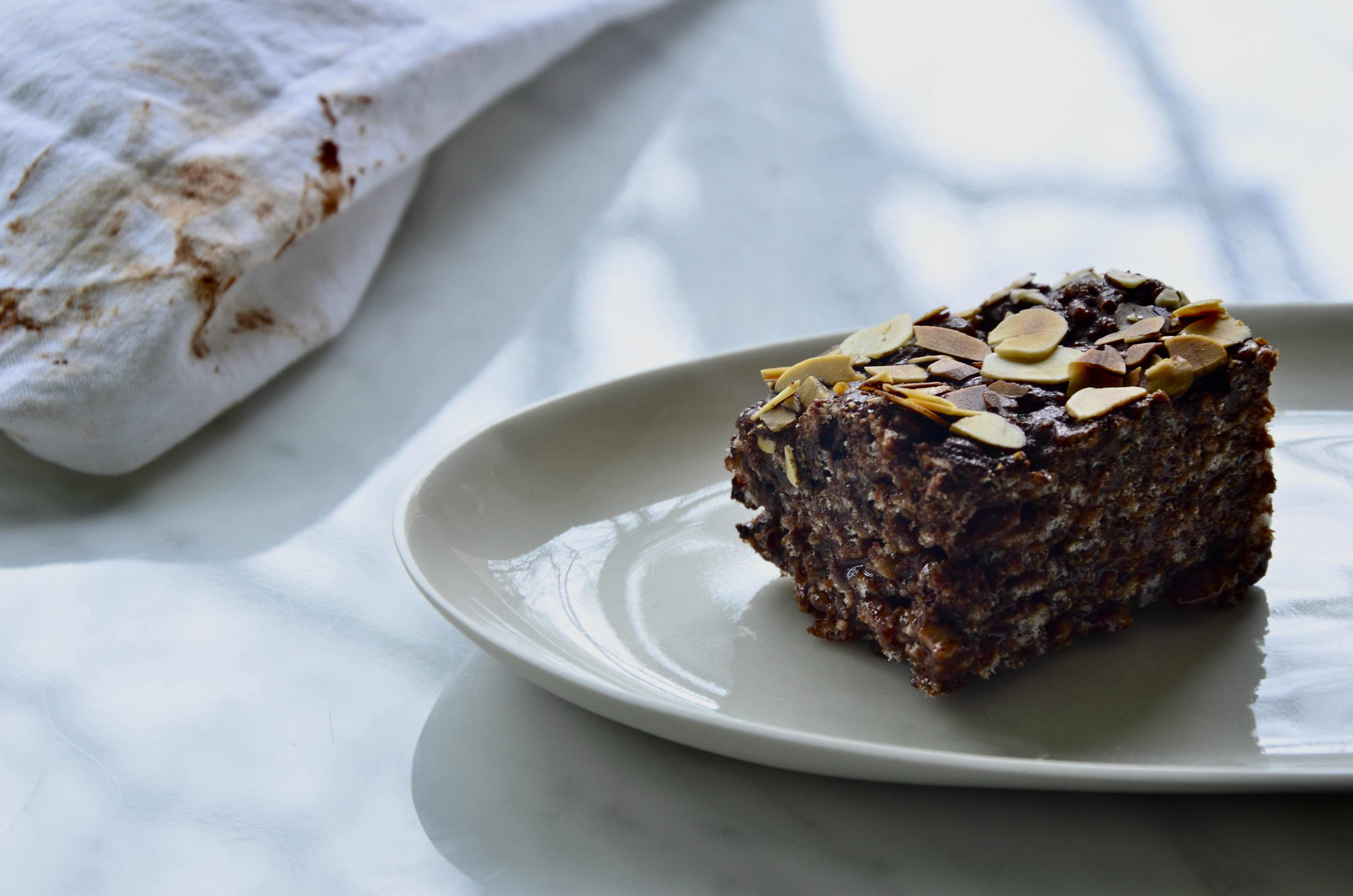
My childhood was filled with Rice Krispies squares made by my mother, my grandmother, friends’ mothers, the camp cook, school-fundraisers, church ladies – they were really all-pervasive in their ooey-gooey-sugar-gelatin-corn-syrup kind of way. Well, thanks to Food52 they’ve had an upgrade that’s as pleasing as punch. In this version, they are filled with natural super foods like maple syrup, almond butter, and organic dark chocolate. Who can argue with that? Or resist? Or not take a second one? Or try to hide the last one in the cupboard so no one else will find it? They are lip-licking good and healthy to boot. Try these for the kids’ next lemonade stand – now that it’s spring – and you’ll have a line-up down the street.
1/2 cup maple syrup
1/2 cup brown rice syrup
1/2 cup almond butter
1/2 cup organic bittersweet chocolate, chopped
2 tbsps coconut oil
1/4 tsp sea salt
4 cups rice crispies
2 tbsps coconut oil
1/2 cup organic bittersweet chocolate, chopped
1/4 cup toasted sliced almonds
1/4 tsp flakey sea salt
Line an 8×8 square pan with a sling of parchment paper. In a large saucepan, bring the maple and rice syrups to a rolling boil for 1 minute, stirring frequently with a heatproof spatula or wooden spoon (be careful not to let it boil over). Remove from the heat and stir in the nut butter, 1/2 cup chocolate, 2 tablespoons coconut oil, and 1/4 teaspoon fine salt until everything is smooth and the chocolate is melted. Fold in the rice cereal and pack the mixture firmly and evenly into the lined pan (damp fingers can help here).
In a double boiler, or a metal bowl over a pot of boiling water, melt the remaining 1/2 cup of chocolate and 2 tablespoons coconut oil together over very low heat, stirring constantly just until melted. Pour the chocolate mixture over the rice mixture, spreading it smooth. Sprinkle the nuts and flaky salt over the top.
Let the bars set at cool room temperature (about 2 hours) or in the refrigerator (about 1 hour) until firm. Lift the sling out of the pan, trim away the edges if you like, and cut into 16 squares.
sweet potato pasta with andrew’s famous pasta sauce
April 26, 2013
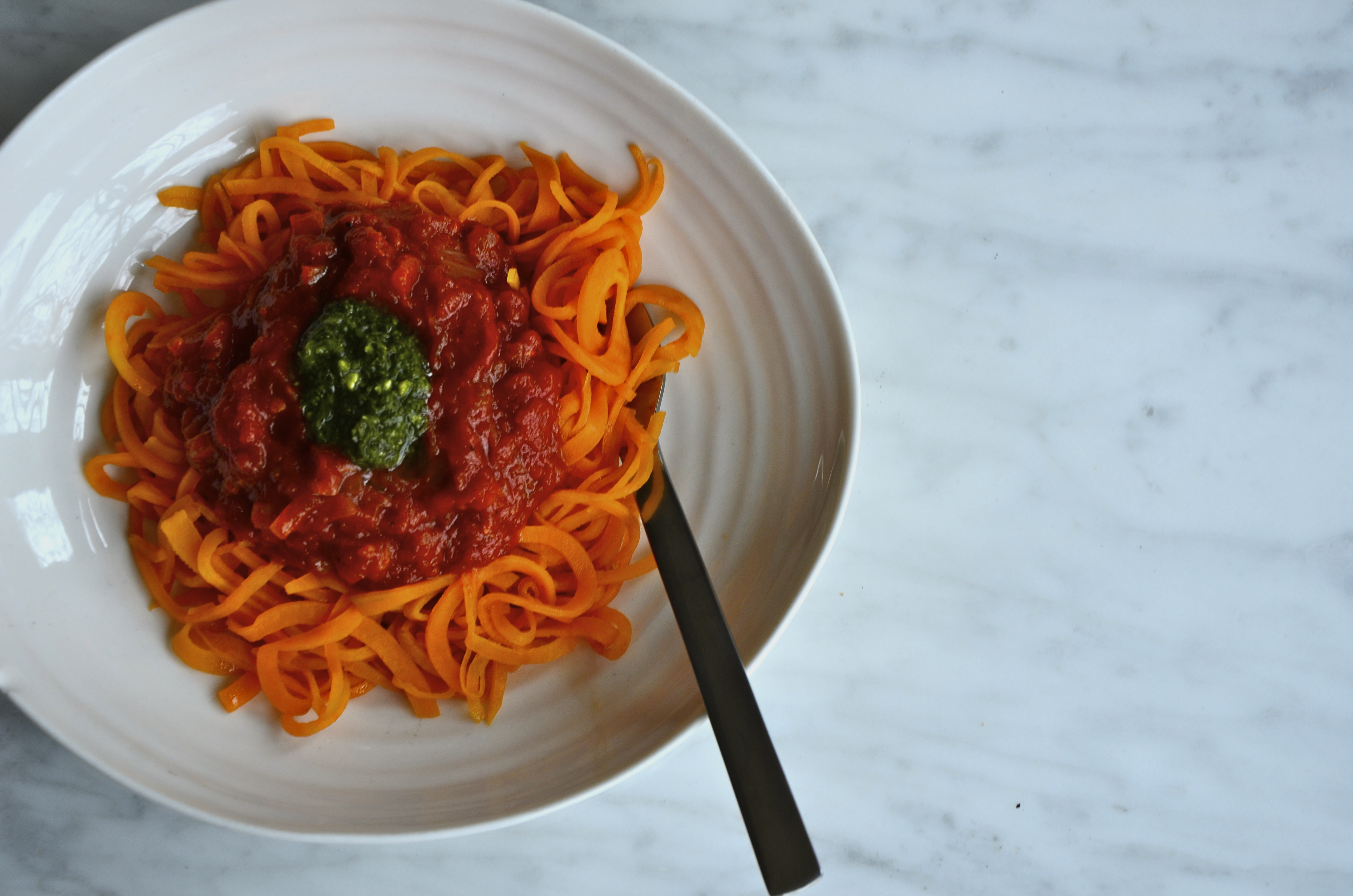
I don’t know why every restaurant in the city serving pasta doesn’t have a veggie pasta option on its menu. It’s incredibly delicious, gluten-free, healthy, and – as you can see – very colourful. I got this pasta from the farmers’ market. Bob and Juli Proracki have a sweet potato farm in Norfolk county. From the Ukraine, via Manitoba, to Ontario, converting a tobacco farm into a hub of sweet potato production, Bob and Juli sell a number of varieties of sweet potato in their raw form and as prepared food. They sell “spiralized” raw sweet potato but if you don’t have access to Bob and Juli’s sweet potato pasta and/or you can’t find it already cut and ready to go somewhere else, you can buy a spiralizer in most good kitchen shops or online. I’ve topped these beautiful ribbons with my husband’s famous pasta sauce for which I’m going to give you the recipe. You saw it here first. Enjoy.

3 tbsps olive oil
4 onions, coarsely chopped
2 cans whole plum tomatoes
1/2 tsp chili pepper flakes, crushed or ground
2 tbsps sugar
sea salt and pepper to taste
6 – 8 garlic cloves, minced finely
Spiralized sweet potato pasta
Heat olive oil in a large skillet. Sauté onions until soft and translucent. Add tomatoes and boil down. Add chili pepper flakes (Andrew puts his in a pepper grinder and grinds them in), sugar (this is important if you don’t live in Sicily; if you have awesome Italian tomatoes baked in the Mediterranean sun you might not need the sugar), and sea salt and pepper to taste. Let simmer. Add minced garlic at the end and you’re done. No need to really cook the garlic. Just add, stir, and set the sauce aside until you’re ready to use.
Meanwhile, steam spiralized sweet potato pasta in a steamer for 5 minutes or until al dente.
Serve in a warm bowl generously topped with pasta sauce and a dollop of kale oregano pesto.
tempeh with fenugreek curry cream
April 20, 2013
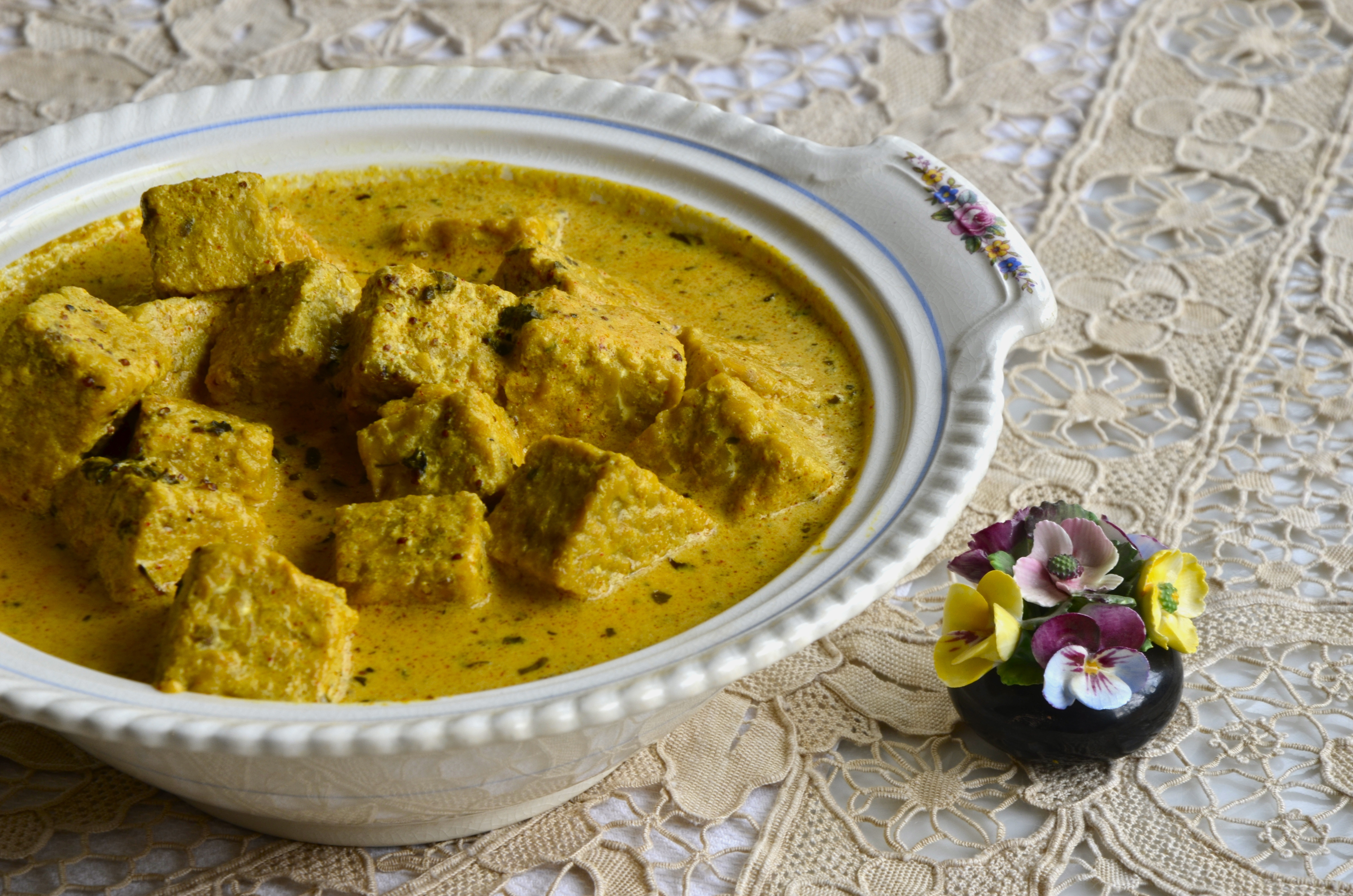
We were at friend’s for dinner last week and, alongside some awesome vegan dishes, they served Vij’s Lamb Popsicles with Fenugreek Curry Cream. Really tasty sauce. And it got me thinking that it could be easily veganized and served with tempeh. So I tried it and guess what? It worked! Here it’s served in my late-grandmother’s china (God bless her beautiful soul!). I have such fond memories of setting the table with this china in her farm kitchen with the view of her garden out the window and the sounds of birds and cows and children flooding in through her gauzy curtains. We’d sit, say grace, and then load up our plates with chicken, her home-grown potatoes and carrots, and crunchy beans straight from the garden. The reason I’m telling you this is that she would have no clue what tempeh is, or fenugreek, or curry cream. In fact, she would hardly recognize most of the ingredients on the list including turmeric, cayenne or paprika. Even grainy yellow mustard. It occurred to me today as I spooned this tasty, spicy dish into her china bowl, how amazing it is that so much has changed in just two generations – how the world of food has opened up for many of us fortunate enough to live at a time and in places where cultures are colliding and influencing one another. So here’s to Vij’s original Indian recipe. And here’s to the veganized version. And here’s to my grandmother’s china that doesn’t know what hit it!
Tempeh:
1/4 cup sweet white wine
1/3 cup grainy yellow mustard
1/2 tsp each salt & freshly ground black pepper
3 packages of tempeh, cut into large cubes
Curry Sauce:
2 cups soy cream
1/4 tsp salt
1/2 tsp paprika
1/4 tsp ground cayenne pepper
1 1/2 tsp dried green fenugreek leaves or crushed seeds
2 Tbsp lemon juice
1-2 Tbsp canola oil
2 garlic cloves, crushed
1 tsp turmeric
In a bowl, combine the wine, mustard, salt and pepper. Add tempeh, stirring to coat, cover or seal and refrigerate for 2 to 4 hours.
In a medium bowl whisk together the soy cream, salt, paprika, cayenne, fenugreek leaves and lemon juice. Heat the oil in a heavy skillet set over medium-high heat and sauté the garlic until golden. Stir in turmeric and cook for 1 minute. Stir in the cream mixture and cook over medium-low heat for about 5 minutes, or until thickened.
Preheat your grill or set a heavy cast iron skillet over high heat; remove tempeh from its marinade and grill (or cook in a hot skillet drizzled with oil) for 3-4 minutes until warmed through and browned. Pour the cream curry over the tempeh or ladle it into a small bowl and use it as a dipping sauce. Serves 4-6.
black pepper tofu
April 13, 2013
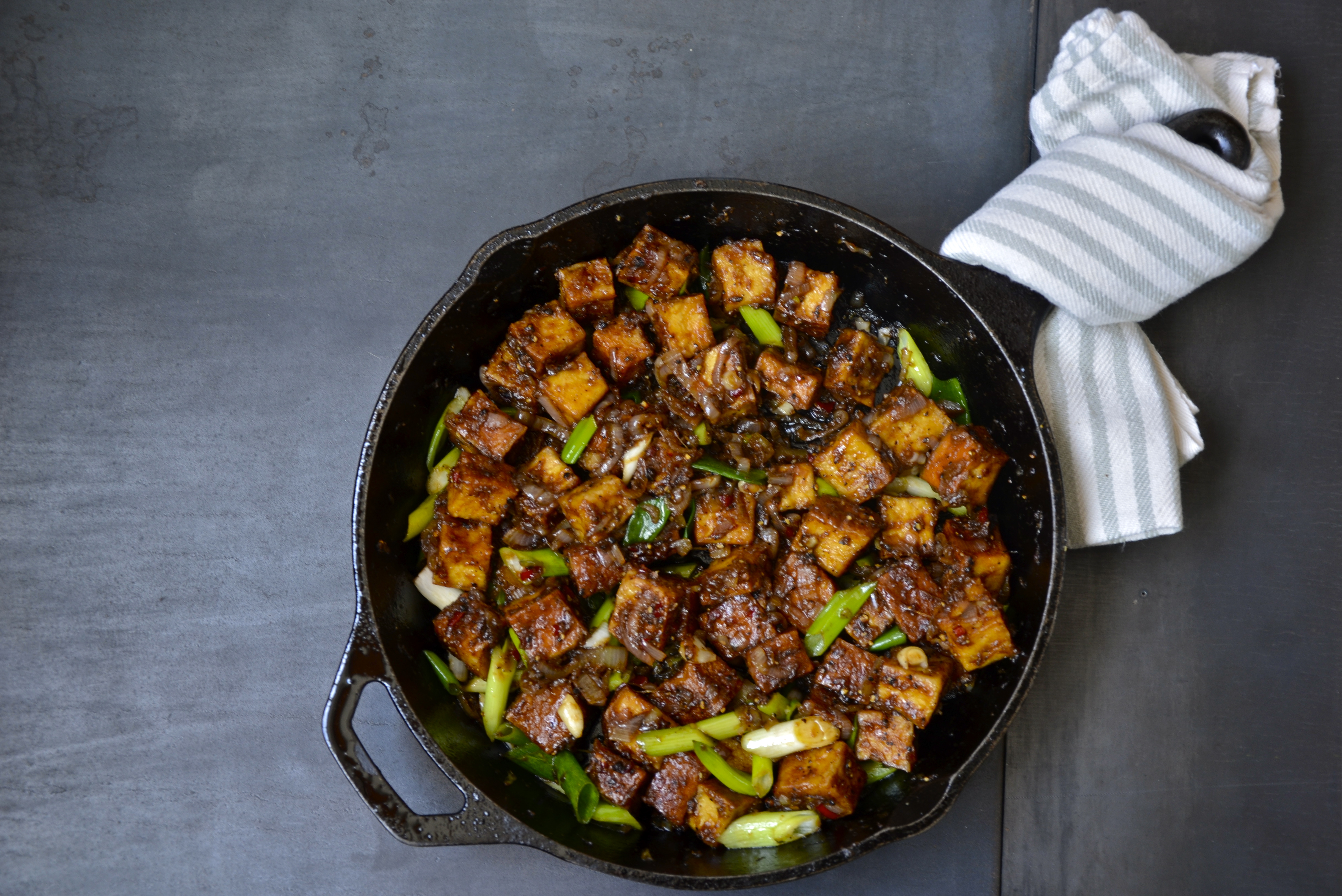
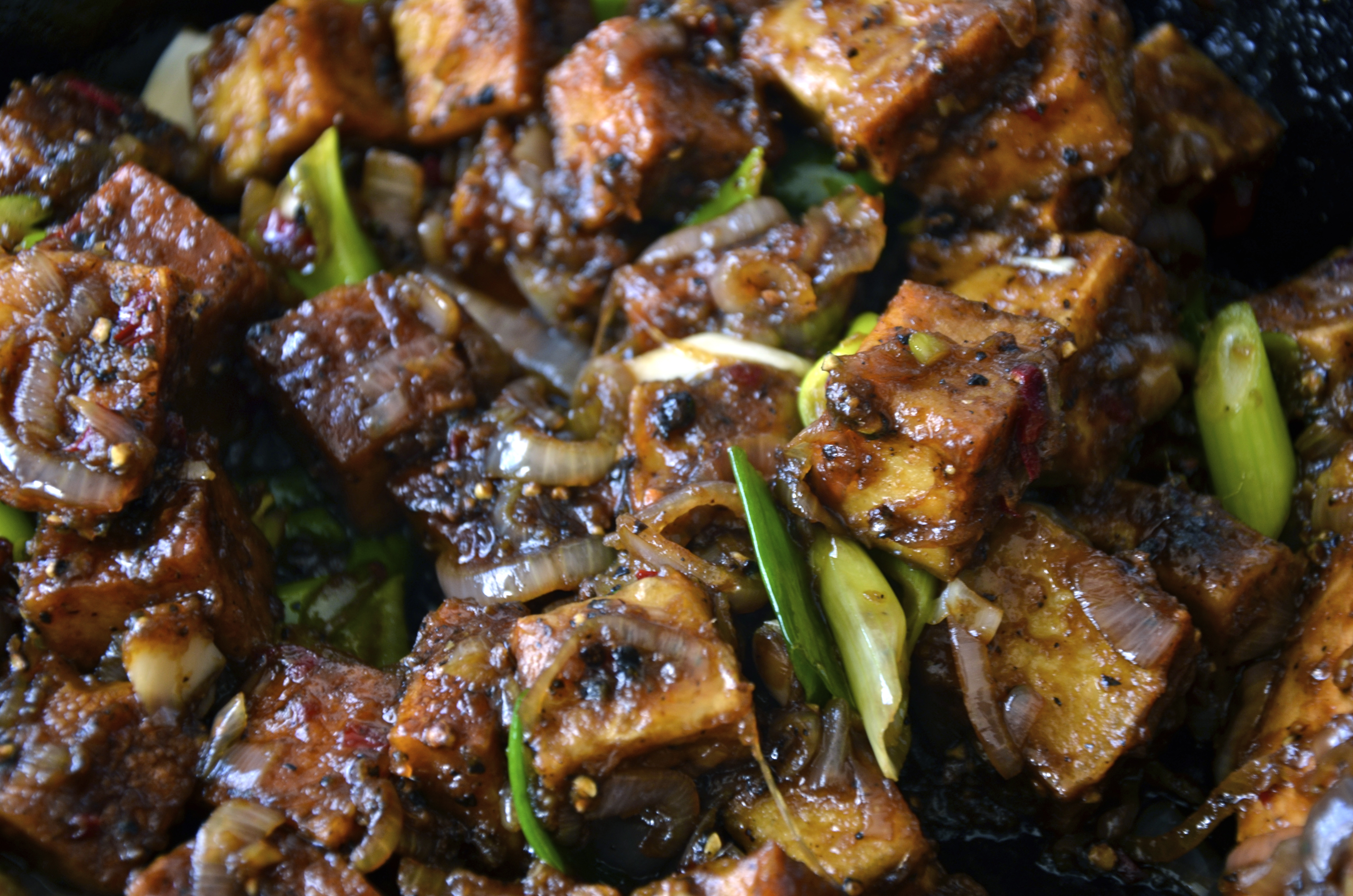
This recipe will give you a serious kick in the pants which is kind of what I need this afternoon after staying up until 2:00 AM with Rebekah and her buddies from camp debating the merits of a local food system with soul at its centre. Long story. All that’s relevant here, really, is that the neurons aren’t firing at full capacity and this black pepper tofu – with its heavy dose of black pepper, hot chile pepper, garlic, and ginger – is kind of what the doctor ordered to give me a little jolt and help me through the day. I used this fabulous smoked tofu from Salt Spring Island that my friend Anne brings each time she comes to visit. But the dish is just as good – it sings just as spicily, gingerly, and zestily – with good old fashioned plain tofu. It’s adapted from the amazing Ottolenghi and is a great dish with rice and veg like steamed broccoli or lightly sautéed baby bok choi on the side.
1 lb firm tofu
Vegetable oil for frying
1 tbsp cornstarch or potato starch
1 tbsp flour
6 small shallots, thinly sliced
1 fresh red chile pepper, thinly sliced
4 garlic cloves, crushed
2 tbsps chopped fresh ginger
5 tbsps tamari sauce
2 tbsp sugar
3 tbsps coarsely crushed black peppercorns (use a mortar and pestle or a spice grinder)
8 small and thin green onions, cut into 1 1/4-inch segments
Start with the tofu. Pour enough oil into a large frying pan or wok to come 1/4 inch up the sides and heat. Cut the tofu into large cubes, about 1 x 1 inch. Toss them in the corn (potato) starch and flour and shake off the excess, then add to the hot oil. (You’ll need to fry the tofu pieces in a few batches so they don’t stew in the pan.) Fry, turning them around as you go, until they are golden all over and have a thin crust. As they are cooked, transfer them onto paper towels.
Remove the oil and any sediment from the pan, then add some clean oil to the pan. Add the shallots, chiles, garlic and ginger. Sauté on low to medium heat for about 15 minutes, stirring occasionally, until the ingredients have turned shiny and are totally soft. Next, add the tamari and sugar and stir, then add the crushed black pepper.
Add the tofu to warm it up in the sauce for about a minute. Finally, stir in the green onions. Serve hot, with steamed rice.
shiitake kombu dashi
April 6, 2013

I mentioned last week that I was doing some spring cleaning in my fridge. Well, not only did I find a bunch of winter vegetables for this fabulous winter stew, I also found some gorgeous shiitake mushrooms that had dried their way to spring in a brown bag. They were fine, just brittle and forgotten. But nothing was lost because I threw them in a pot with water and kombu and, presto, I had awesome shiitake kombu dashi. What is shiitake kombu dashi? It’s an amazing stock made from mushrooms and seaweed that can be used in soups (especially as the base to miso soup), to cook rice, as a broth when you’re in need of soul food, or to simmer vegetables to give them added flavour.
1 1/2 oz dried shiitake mushrooms
2/3 oz dried kombu kelp
2 litres water
Throw the shiitake and kombu in a large stock pot. Add water and heat until the water just starts to boil. Before it begins to really boil, turn the heat down to low and let it simmer for about 50 minutes. Remove the shiitake and kombu and strain the stock through a sieve lined with cheesecloth or tea towels.
goodbye winter stew with rutabaga carrots and potatoes
April 1, 2013

I’m invoking the spring. It’s April 1st and for many of you, you will be skipping amongst the tulips. But for us here in Toronto it’s windy, and cold, and – yes – snowing. Grumpiness abounds. So, to invoke the spring I’ve decided to clean out my fridge of all the winter hangers-on like rutabaga, carrots, and potatoes. Deborah Madison in her new (fabulous!) cookbook Vegetable Literacy, has the perfect recipe for these 3 rooty vegetables that are often relied upon to get us through the darkness of our darkest months. “Mustard grounds the sweetness of the vegetables” and a lovely parsley sauce contributes to the prayer for sun, warmth, and longer days with its green intensity and fresh springy taste. It’s goodbye winter. Hello spring. Bring on the fresh asparagus, spinach, and baby greens … after I finish another serving of the stew.

Winter Stew
2 tbsps olive oil
2 onions, diced
1 large rutabaga, thickly peeled and diced into large chunks
2 or 3 red potatoes, scrubbed and diced into large chunks
6 carrots, scrubbed, but into 1 inch lengths and wider ends cut in half
2 sprigs thyme
2 bay leaves
sea salt
1 cup water or vegetable stock
2 to 3 tsps mustard, dijon or dijon a l’ancienne
ground black pepper
Parsley Sauce
1 clove garlic
sea salt
1/4 tsp black peppercorns
1/4 tsp fennel seeds
3/4 cup finely chopped parsley
3/4 cup olive oil
1 large shallot
Grated zest of 1 lemon
Fresh lemon juice or sherry vinegar
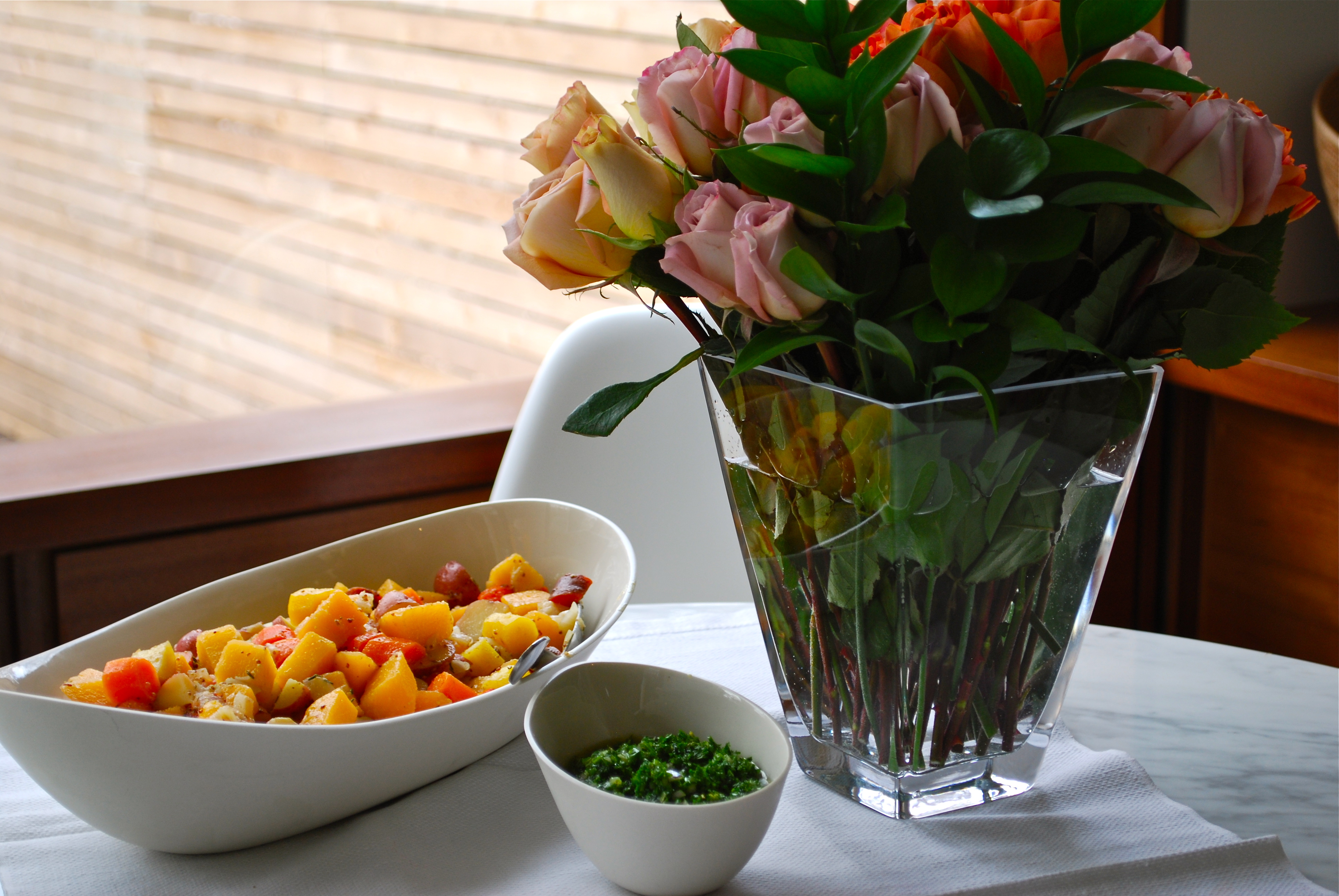
Heat the oil in a wide saute pan with a lid over medium heat. Add the onion, rutabagas, potatoes, carrots, thyme, and bay leaves, turn to coat, and season with 1 teaspoon salt. Cook over medium heat for 10 minutes, stirring occasionally. Add the water, cover, turn the heat to medium low, and cook for 20 minutes. Check to see how tender the vegetables are and how much liquid is left. When the vegetables are nearly tender, stir in the mustard and then continue cooking without the lid to reduce the cooking liquid.
Remove and discard the bay and thyme. Taste for salt and season with pepper.
Meanwhile, for the parsley sauce, pound the garlic in a mortar with 1/4 tsp salt, the peppercorns, the fennel seeds, and 2 tablespoons of the parsley to make a smooth paste. If the mixture seems to dry to handle well, add a little of the olive oil. Stir in the rest of the parsley, the shallot, the lemon zest, adn the oil to make a thick green sauce. Taste for salt, then sharpen with a little vinegar.
Serve the veggie stew as a side dish, or as a light dinner over rice or quinoa. However you serve it, finish each serving with a spoonful of the sauce or a scattering of minced parsley. The veggie stew can also become a soup with the addition of more liquid, or a puree with a spin in the food processor or a food mill. The sauce goes equally well with any iteration.
 v:gourmet